US Map / Time Zones / Mountain Time
Mountain Time Zone Map
The least populated zone in the contiguous states, and the only one where a whole state sits out daylight saving time.
Mountain Time in one paragraph
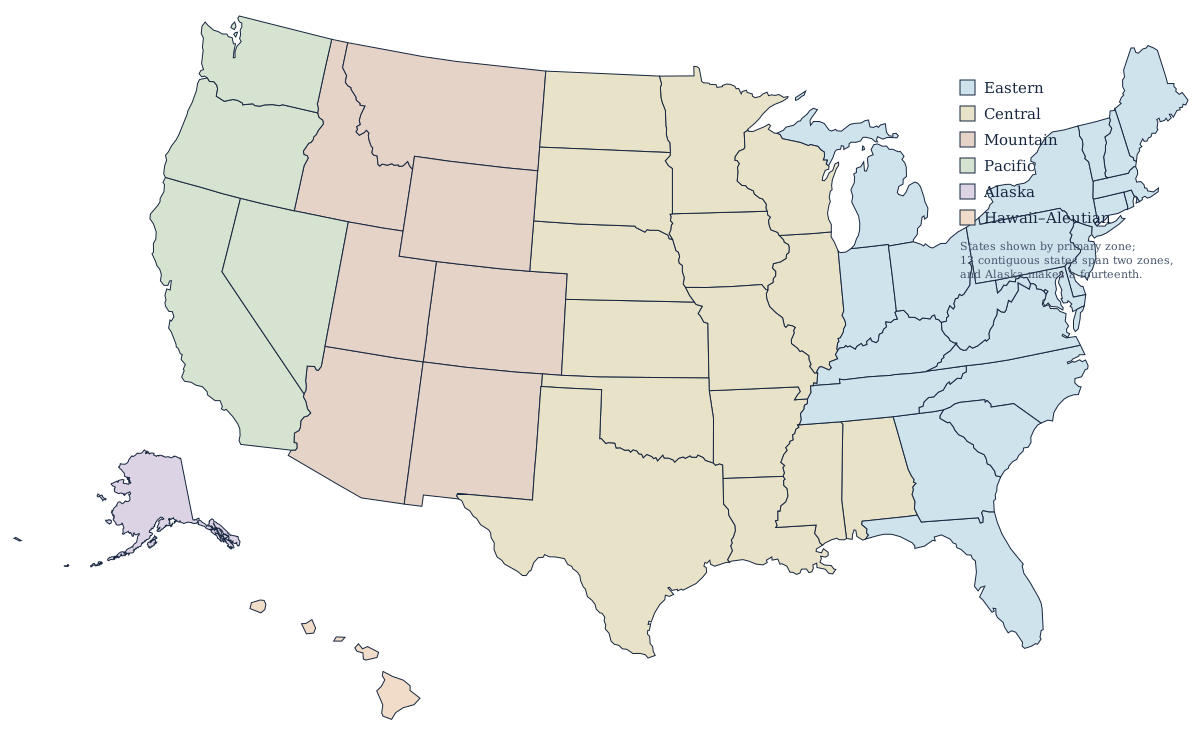
Fewer people live on Mountain Time than on any other zone in the contiguous United States — roughly seven percent of the national population — and one of the states in it does not change its clocks at all. Six states are wholly inside the zone; eight more contribute a corner, a panhandle, or in one case a single town.
Those six are the core of the Mountain division. The partial members are Idaho, Kansas, Nebraska, Nevada, North Dakota, Oregon, South Dakota, and Texas.
Arizona and daylight saving time
Arizona has not observed daylight saving time since 1968. It stays on Mountain Standard Time year round, so from March to November it reads the same clock as Los Angeles and an hour behind Denver, and from November to March it reads the same clock as Denver and an hour ahead of Los Angeles. The exception inside the exception is the Navajo Nation, which does observe daylight saving across its Arizona, Utah, and New Mexico sections — and the Hopi Reservation, entirely surrounded by the Navajo Nation, does not. Northeastern Arizona in summer therefore contains concentric areas an hour apart.
The eight partial states, one by one
Texas keeps El Paso and Hudspeth counties on Mountain Time, aligning El Paso with New Mexico rather than with the rest of its own state. Kansas contributes Sherman, Wallace, Greeley, and Hamilton counties on the Colorado line; Nebraska its western panhandle; South Dakota everything west of roughly the Missouri River, including Rapid City; and North Dakota its southwestern corner. Idaho splits at the Salmon River: the northern panhandle around Coeur d'Alene, Moscow, and Lewiston runs on Pacific Time with Spokane, while Boise and the south are Mountain. Oregon keeps just Malheur County on Mountain Time so that Ontario, Oregon, matches Boise across the river, and Nevada does the same for West Wendover, a casino town on the Utah line whose business comes from Salt Lake City.
UTC offset: MST and MDT
| Standard time (MST) | UTC−7 |
| Daylight time (MDT) | UTC−6, except in most of Arizona |
| Clocks forward | 2:00 a.m. on the second Sunday in March |
| Clocks back | 2:00 a.m. on the first Sunday in November |
| States wholly in the zone | 6 |
| No daylight saving | Arizona, apart from the Navajo Nation |
Every Mountain state except Arizona keeps the national March-to-November daylight saving schedule. What Arizona used in 1968 is the one exit federal law leaves open: a state may exempt itself from daylight saving and stay on standard time all year, but it cannot put itself permanently on daylight time without an act of Congress. That asymmetry is why the country has year-round-standard-time states and no year-round-daylight-time ones. Largest cities on the zone: Phoenix, Denver, Albuquerque, Tucson, Mesa, Colorado Springs, Aurora, and Salt Lake City, with Boise and El Paso at the edges.
Zones either side
East is Central Time, west is Pacific, and further out are Alaska and Hawaii–Aleutian. The time zones hub has the comparison table, and the West region page covers the same territory geographically.