US Map / Time Zones / Alaska Time
Alaska Time Zone Map
A state wide enough for four time zones that deliberately uses one, so that Juneau and Nome can do business on the same working day.
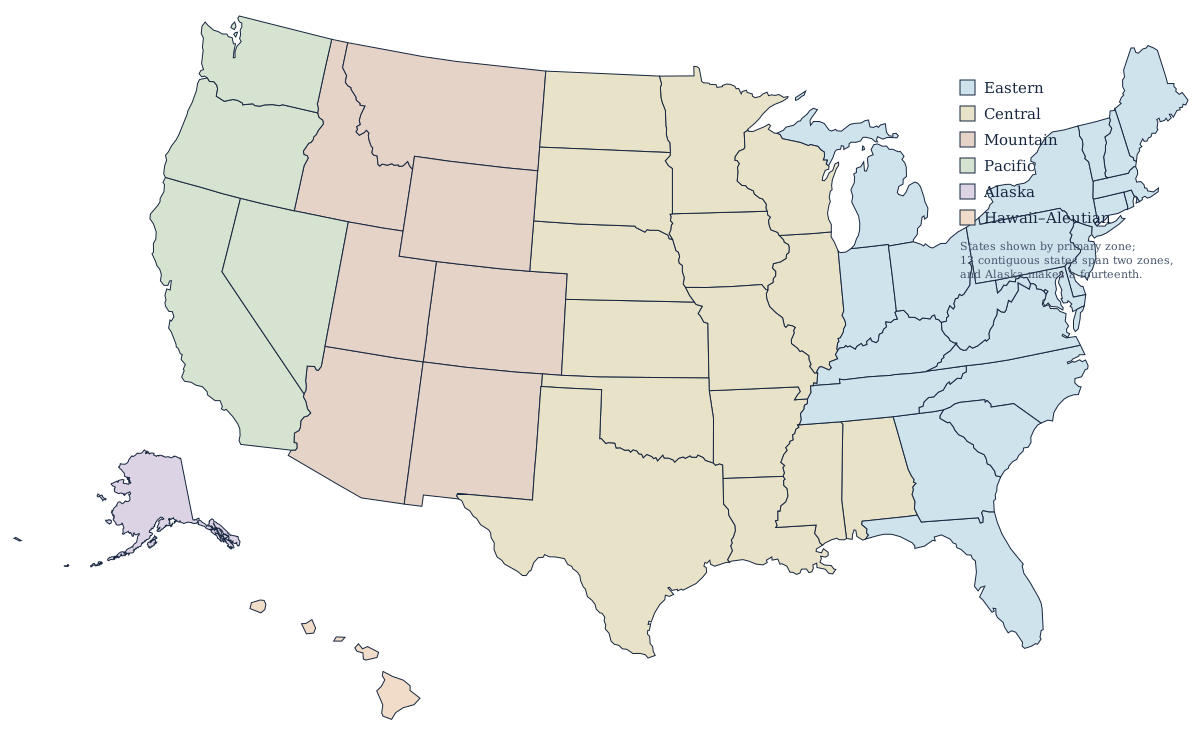
One zone for a state a fifth the size of the Lower 48
Alaska is wide enough to justify four time zones on longitude alone. It uses one. Since October 1983 almost the entire state has run on Alaska Time, UTC−9, after the state government asked the federal Department of Transportation to consolidate what had been four separate zones so that business could be done across Alaska in a single working day. Before that change Anchorage and Juneau were on different clocks.
| Standard time (AKST) | UTC−9 |
| Daylight time (AKDT) | UTC−8 |
| Clocks forward | 2:00 a.m. on the second Sunday in March |
| Clocks back | 2:00 a.m. on the first Sunday in November |
| States in the zone | Alaska only |
| Not included | Aleutian Islands west of 169°30′W |
What the zone does and doesn't cover
Alaska Time covers everything from the Southeast panhandle at Ketchikan and Juneau through Anchorage, Fairbanks, and Nome to the Alaska Peninsula and the eastern Aleutians. The exception is the far western chain: the Aleutian Islands west of 169°30′W, including Adak and Atka, keep Hawaii–Aleutian Time, one hour further behind. The line matters more on paper than in practice, since only a few hundred people live west of it, but it is the reason the zone is named for both Hawaii and the Aleutians.
The Aleutian chain runs far enough west to cross the 180th meridian: Attu, at the end of it, sits at about 173 degrees east longitude, in the eastern hemisphere. The International Date Line jogs west around the whole chain so that every part of Alaska keeps the same calendar date, the same way it bends east around eastern Siberia. In the Bering Strait the two effects meet: Little Diomede Island is American and Russia's Big Diomede lies less than three miles away, with 21 hours of clock difference between them.
Daylight saving and daylight
Alaska keeps the national daylight saving schedule, clocks forward in March and back in November, and the hour it moves is trivial against the daylight the state actually gets. Almost all of Alaska lies west of the 135th meridian that UTC−9 is centered on, so in summer solar noon in Anchorage falls at around two in the afternoon and the evenings run very late by the clock even in the south. Anchorage gets about nineteen hours between sunrise and sunset at the June solstice and about five and a half hours at the December solstice; north of the Arctic Circle, Utqiagvik has roughly two and a half months of continuous daylight in summer and about two months without a sunrise in winter. Bills to drop the clock change come back to the state legislature regularly and have not passed.
Cities, and where the zone sits
Anchorage is the only Alaskan city among the 100 largest in the country and holds roughly two-fifths of the state's population. Fairbanks and Juneau are the next largest, and Juneau, the capital, is the only US state capital that cannot be reached by road. Alaska Time is one hour behind Pacific Time, so Seattle is always an hour ahead of Anchorage; it is four hours behind Eastern, three behind Central, and two behind Mountain. Alaska belongs to the Pacific division of the West. The US time zones map shows all six zones together.